
Amrut Ai
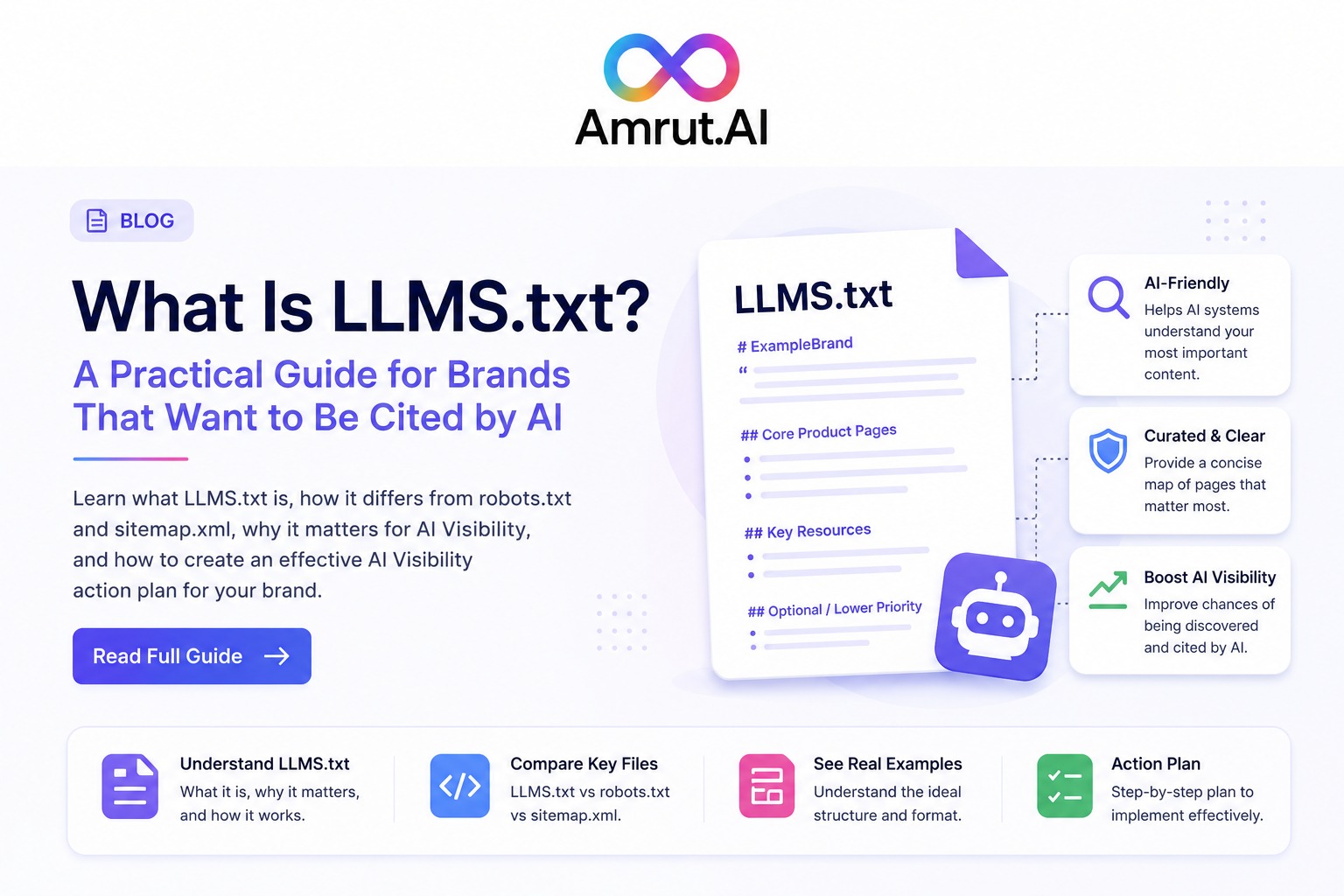
What Is LLMS.txt? A Practical Guide for Brands That Want to Be Cited by AI
AI search is changing how buyers discover brands. A prospect may now ask ChatGPT, Claude, Perplexity, Gemini, Google AI Mode, or another AI system to compare SEO tools, audit platforms, analytics dashboards, YouTube SEO software, backlink monitors, or AI content generators. If your brand is not understood, retrieved, or cited, you may be invisible at the moment of consideration.
That is where LLMS.txt enters the AI Visibility conversation. It is not a magic ranking file. It does not guarantee citations. But used correctly, it can become part of a practical AI Visibility action plan: a lightweight, machine-readable map that helps AI agents and retrieval systems understand what your site is, which pages matter, and where to find reliable source material.
What Is LLMS.txt?
LLMS.txt is a proposed Markdown-based file, usually placed at /llms.txt, that gives large language models and AI agents a concise, curated overview of a website. The original proposal by Jeremy Howard describes it as a way to provide information that helps LLMs use a website at inference time, especially when a full site is too large, noisy, or JavaScript-heavy for an AI system to process efficiently. (llmstxt.org)
The current LLMS.txt convention generally includes:
- One required H1 heading naming the site or project.
- An optional blockquote summary.
- Short explanatory notes.
- H2 sections containing curated links to important pages.
- An optional section for lower-priority resources that can be skipped when context is limited. (llmstxt.org)
Google’s Lighthouse documentation now describes llms.txt as an emerging convention for providing a machine-readable summary for LLMs and AI agents, while also noting that the file is optional. (developer.chrome.com)
LLMS.txt vs robots.txt vs sitemap.xml
| File | Main Purpose | Best For | Benefits | Limitations | Implementation Effort |
| robots.txt | Crawl access rules for bots | Allowing or disallowing crawler access | Standardized by RFC 9309; widely recognized by reputable crawlers | Not access control or security; bad bots may ignore it | Low |
| sitemap.xml | URL discovery for search engines | Helping crawlers find canonical URLs and last-modified dates | Supports large sites, sitemap indexes, and up to 50,000 URLs per sitemap | Does not explain brand positioning or content meaning | Low–medium |
| llms.txt | Curated AI-readable context | Helping AI agents understand your most important resources | Human-readable Markdown; useful for docs, product pages, pricing, APIs, comparisons, and help content | Emerging convention; not guaranteed to be used by all AI systems | Low |
| Structured data | Entity and page-level markup | Products, FAQs, reviews, articles, local business details | Helps eligible rich results and machine interpretation | No special schema is required for Google generative AI search | Medium |
robots.txt is a rules file. RFC 9309 defines how automated crawlers should interpret user-agent groups, allow/disallow rules, access behavior, caching, and other protocol details. It also explicitly says robots rules are not a substitute for real security controls. (rfc-editor.org)
sitemap.xml is a discovery file. The Sitemaps protocol requires URL entries and supports optional fields such as lastmod, while larger sites can use sitemap indexes. Sitemaps.org also states that sitemaps tell search engines what content you would like indexed, not what to exclude. (sitemaps.org)
llms.txt is different: it is an orientation layer. It tells AI systems, “Here are the pages that best explain who we are, what we do, and what should be cited.”
Example LLMS.txt Structure
# ExampleBrand
> ExampleBrand is an AI SEO platform for marketers, founders, CTOs, and SEO analysts who want to monitor AI Visibility, generate AI-ready website files, and improve discoverability across search and answer engines.
## Core Product Pages
- [AI Visibility Platform](https://example.com/ai-visibility): Tracks brand mentions, citations, sentiment, and competitor presence across AI search experiences.
- [LLMS.txt Generator](https://example.com/llms-txt-generator): Creates a curated AI-readable file for important site resources.
- [SEO Audit Tool](https://example.com/seo-audit): Audits crawlability, indexability, schema, backlinks, and content gaps.
## Helpful Resources
- [AI Visibility Guide](https://example.com/blog/ai-visibility-guide): Explains how brands can measure and improve AI search presence.
- [API Documentation](https://example.com/docs): Developer documentation for integrations.
## Optional
- [Careers](https://example.com/careers): Company hiring page.
- [Press](https://example.com/press): Media mentions and brand assets.
Keep it concise. Do not paste your entire website into llms.txt. Link to the best source pages instead.
Why LLMS.txt Matters for AI Citations
AI citation systems often depend on retrieval. Google’s generative AI search documentation explains that AI Overviews and AI Mode use retrieval-augmented generation and query fan-out to retrieve relevant pages from Google’s Search index before generating responses with links. (developers.google.com)
That does not mean LLMS.txt is a Google ranking factor. Google’s July 2026 guidance is explicit: Google Search does not use LLMS.txt files for visibility or ranking, and creating one will neither help nor harm Google Search rankings. (developers.google.com)
So why create one?
Because AI Visibility is broader than Google. OpenAI, Anthropic, Perplexity, Common Crawl, browser agents, documentation assistants, and third-party AI tools all interact with websites differently. OpenAI separates crawlers such as OAI-SearchBot, GPTBot, and ChatGPT-User, each with different purposes. (platform.openai.com) Anthropic similarly distinguishes ClaudeBot, Claude-User, and Claude-SearchBot. (support.anthropic.com) Perplexity documents both PerplexityBot and Perplexity-User, including guidance for robots.txt and WAF access. (docs.perplexity.ai)
In other words, LLMS.txt is best understood as an AI assistance layer, not an SEO shortcut.
Data-Backed Context: Adoption Is Still Early
The 2025 Web Almanac by HTTP Archive analyzed 17.2 million websites and 244 TB of open-source data. Its SEO chapter reported that valid llms.txt files appeared on only 2.13% of desktop sites and 2.10% of mobile sites, making adoption early but measurable. (almanac.httparchive.org) (almanac.httparchive.org)
The same report found that robots.txt remains much more common, appearing on about 94.1% of roughly 12.9 million analyzed sites with at least one directive. (almanac.httparchive.org)
The takeaway: LLMS.txt is not mature like robots.txt or sitemap.xml. But early adoption may still be useful for brands that want to make their best source material easier for AI agents, auditors, and retrieval tools to find.
Where Amrut.AI Fits
For brands that need more than a hand-written Markdown file, Amrut.AI provides an LLMS.txt Generator that can generate structured llms.txt files from a public domain, provide preview/edit workflows, and support export or public-view use cases. (amrut.ai)
Amrut.AI also positions its platform around AI SEO, competitor analysis, keyword research, backlink gaps, content generation, YouTube SEO, and an advanced LLMS generator. (amrut.ai)
Amrut.AI vs Competitor AI Visibility Tools
| Tool | Best For | Benefits | Limitations | Recommended Use Case |
| Amrut.AI | LLMS.txt generation + AI Visibility workflow | Purpose-built LLMS.txt generation, SEO files, AI SEO modules, competitor and content workflows | Teams should validate output accuracy before publishing | Brands that want a fast detailed and free LLMS.txt generator plus broader AI SEO tooling |
| Semrush | Enterprise SEO + AI visibility tracking | AI Visibility Toolkit and Semrush One combine SEO and AI visibility workflows | Broader suite may be more than a small team needs | Teams already invested in Semrush SEO operations (semrush.com) |
| Similarweb | Market, traffic, and competitor intelligence | Gen AI Intelligence monitors brand visibility in AI chatbots and benchmarks competitors | More analytics-focused than file-generation-focused | Market intelligence and competitor traffic teams (support.similarweb.com) |
| Writesonic | GEO and AI content workflows | Tracks AI visibility, citation share, and platforms such as ChatGPT, Perplexity, Gemini, Copilot, Claude, and others | Content-led teams may still need technical SEO validation | Content teams building GEO campaigns (docs.writesonic.com) |
| Peec AI | AI search analytics | Tracks visibility, position, sentiment, prompts, sources, and competitors | Primarily visibility analytics, not an LLMS.txt-first platform | Marketing teams focused on AI answer monitoring (peec.ai) |
| Ahrefs | SEO, brand radar, and AI visibility research | Brand Radar tracks brand presence across AI platforms and other channels | AI visibility workflows may be separate from LLMS.txt creation | SEO teams that want AI visibility alongside links and keyword data (help.ahrefs.com) |
AI Visibility Action Plan: How to Implement LLMS.txt
Step 1: Audit your AI-citable assets
Identify pages that should represent your brand in AI answers:
- Product pages
- Pricing pages
- Comparison pages
- Documentation
- API references
- Case studies
- Research reports
- Support articles
- YouTube guides
- Category pages
- Founder or company pages
Step 2: Decide what should not be promoted
Do not include:
- Thin blog posts
- Outdated landing pages
- Internal-only URLs
- Low-quality AI-generated content
- Duplicate pages
- Pages with legal, pricing, or compliance uncertainty
Step 3: Check crawl and index access
Review:
- robots.txt
- Meta robots
- X-Robots-Tag
- Canonicals
- Sitemap coverage
- WAF rules
- Bot access logs
For Google, remember that nosnippet and max-snippet can affect how much content may be used as direct input for AI Overviews and AI Mode. (developers.google.com)
Step 4: Generate your LLMS.txt file
You can create it manually or use a generator. For speed, use Amrut.AI’s LLMS.txt Generator, then manually review every line before publishing. (amrut.ai)
Step 5: Publish at the root
Upload the file here:
https://example.com/llms.txt
Use lowercase. Keep it accessible with a 200 status code.
Step 6: Add supporting Markdown pages where useful
For documentation-heavy sites, consider clean Markdown versions of important docs. The original LLMS.txt proposal recommends Markdown versions of pages where useful for LLM consumption. (llmstxt.org)
Step 7: Monitor AI Visibility KPIs
Track:
- AI mentions
- AI citations
- Share of voice
- Sentiment
- Prompt coverage
- Cited URLs
- Bot access logs
- Referral traffic from AI tools
- Conversion paths from AI-referred sessions
Step 8: Maintain monthly
Update your LLMS.txt whenever you launch new products, change pricing, publish major research, add API docs, or retire old pages.
Industry-Specific Guidance
For digital marketing, SEO tools, AI SEO audit tools, keyword rank trackers, backlink monitoring platforms, competitor analysis tools, analytics dashboards, YouTube SEO tools, and AI content generators, LLMS.txt should prioritize clarity and proof.
Include:
- Product categories and use cases
- Feature pages with concrete explanations
- Comparison pages with fair positioning
- API and integration documentation
- Data methodology pages
- Security and privacy pages
- Pricing and plan pages
- Customer stories only if real and approved
- YouTube SEO or trend pages if video discovery is part of your product
Avoid unsupported claims like “guaranteed rankings,” “best AI SEO tool,” or “100% accurate AI citations” unless independently verifiable.
Illustrative Example: B2B SEO SaaS
Scenario: A hypothetical AI SEO platform sells keyword research, backlink monitoring, competitor ad analysis, YouTube SEO insights, and an AI Visibility dashboard.
Problem: AI tools mention large competitors but ignore the brand.
Action plan:
- Create an LLMS.txt file linking to product, pricing, methodology, and comparison pages.
- Update sitemap and robots.txt.
- Allow search-focused AI bots while reviewing training-crawler policy.
- Improve documentation pages with original examples.
- Track AI mentions and cited URLs weekly.
Expected learning: If citations improve, the team can inspect which source pages were referenced. If nothing changes, the issue may be authority, content quality, crawl access, or lack of third-party mentions—not the LLMS.txt file alone.
This is an illustrative example, not a real customer result.
Common Mistakes
- Treating LLMS.txt as a ranking factor.
- Blocking AI search crawlers while expecting AI citations.
- Listing every URL instead of the best URLs.
- Publishing outdated claims.
- Including confidential or regulated content.
- Forgetting sitemap, schema, robots, and page quality.
- Measuring only traffic, not AI mentions and citations.
LLMS.txt Best-Practice Checklist
- File is available at /llms.txt.
- H1 contains the official brand name.
- Summary explains the brand clearly.
- Links point to canonical, crawlable pages.
- Product, pricing, docs, comparisons, and methodology pages are included.
- Optional pages are separated.
- Claims are fact-checked.
- Legal, privacy, and security pages are included where relevant.
- File is reviewed monthly.
- AI Visibility KPIs are tracked.
FAQs
Is LLMS.txt required for SEO?
No. Google says LLMS.txt is not needed for Google Search or its generative AI features. (developers.google.com)
Can LLMS.txt improve AI citations?
It may help AI agents and tools understand your site, but there is no universal guarantee that AI systems will read it or cite you because of it.
Should I still use robots.txt and sitemap.xml?
Yes. LLMS.txt complements them; it does not replace them.
Should every brand create LLMS.txt?
If your brand depends on AI discovery, technical documentation, product comparisons, or AI-cited content, it is worth testing. If your site is small and rarely updated, a clean sitemap and strong pages may matter more.
Conclusion: LLMS.txt Is a Useful Signal, Not a Silver Bullet
LLMS.txt is an emerging AI-readable website file that can support AI Visibility, AEO, GEO, SEO, and AI SEO workflows. Its value is practical: it gives AI systems a concise map of your most important content.
But the winning strategy is broader: crawlable pages, authoritative content, accurate claims, structured data where useful, clear documentation, strong third-party mentions, and continuous AI Visibility measurement.
CTA: Want to create your first AI-ready file? Try the Amrut.AI LLMS.txt Generator and use it as the starting point for your AI Visibility action plan. (amrut.ai)
Sources and References
- LLMS.txt proposal — llmstxt.org
Publisher: llmstxt.org / Jeremy Howard
Date: September 3, 2024
Relevance: Primary source for the LLMS.txt proposal, file structure, and purpose. (llmstxt.org)
2. LLMS.txt format — llmstxt.org
Publisher: llmstxt.org
Accessed: August 15, 2026
Relevance: Defines the H1, summary, sections, file lists, and optional section conventions. (llmstxt.org)
3. RFC 9309: Robots Exclusion Protocol
Publisher: IETF / RFC Editor
Date: September 2022
Relevance: Authoritative standard for robots.txt behavior and limitations. (rfc-editor.org)
4. Sitemaps Protocol
Publisher: Sitemaps.org
Last updated: November 21, 2016
Relevance: Official reference for sitemap XML requirements and limits. (sitemaps.org)
5. OpenAI Crawlers Documentation
Publisher: OpenAI
Accessed: August 15, 2026
Relevance: Explains OAI-SearchBot, GPTBot, and ChatGPT-User. (platform.openai.com)
6. Anthropic crawler documentation
Publisher: Anthropic / Claude Help Center
Date: April 7, 2026
Relevance: Explains ClaudeBot, Claude-User, and Claude-SearchBot. (support.anthropic.com)
7. Perplexity Crawlers
Publisher: Perplexity
Accessed: August 15, 2026
Relevance: Explains PerplexityBot, Perplexity-User, IP ranges, and WAF guidance. (docs.perplexity.ai)
8. Google guide to optimizing for generative AI features
Publisher: Google Search Central
Last updated: July 10, 2026
Relevance: Official guidance on SEO, AEO/GEO terminology, RAG, query fan-out, and LLMS.txt limitations for Google Search. (developers.google.com)
9. Google robots meta tag documentation
Publisher: Google Search Central
Last updated: March 24, 2026
Relevance: Explains nosnippet, max-snippet, and AI Overviews / AI Mode serving controls. (developers.google.com)
10. Chrome Lighthouse LLMS.txt audit
Publisher: Chrome for Developers
Last updated: May 5, 2026
Relevance: Confirms LLMS.txt as an emerging optional convention for AI agents. (developer.chrome.com)
11. 2025 Web Almanac SEO chapter
Publisher: HTTP Archive / Web Almanac
Published: January 15, 2026; updated June 9, 2026
Relevance: Provides adoption data for LLMS.txt and robots.txt across large-scale web crawls. (almanac.httparchive.org)
12. Amrut.AI LLMS.txt Generator
Publisher: Amrut.AI
Accessed: August 15, 2026
Relevance: Product context for the LLMS.txt generator CTA and implementation workflow. (amrut.ai)