
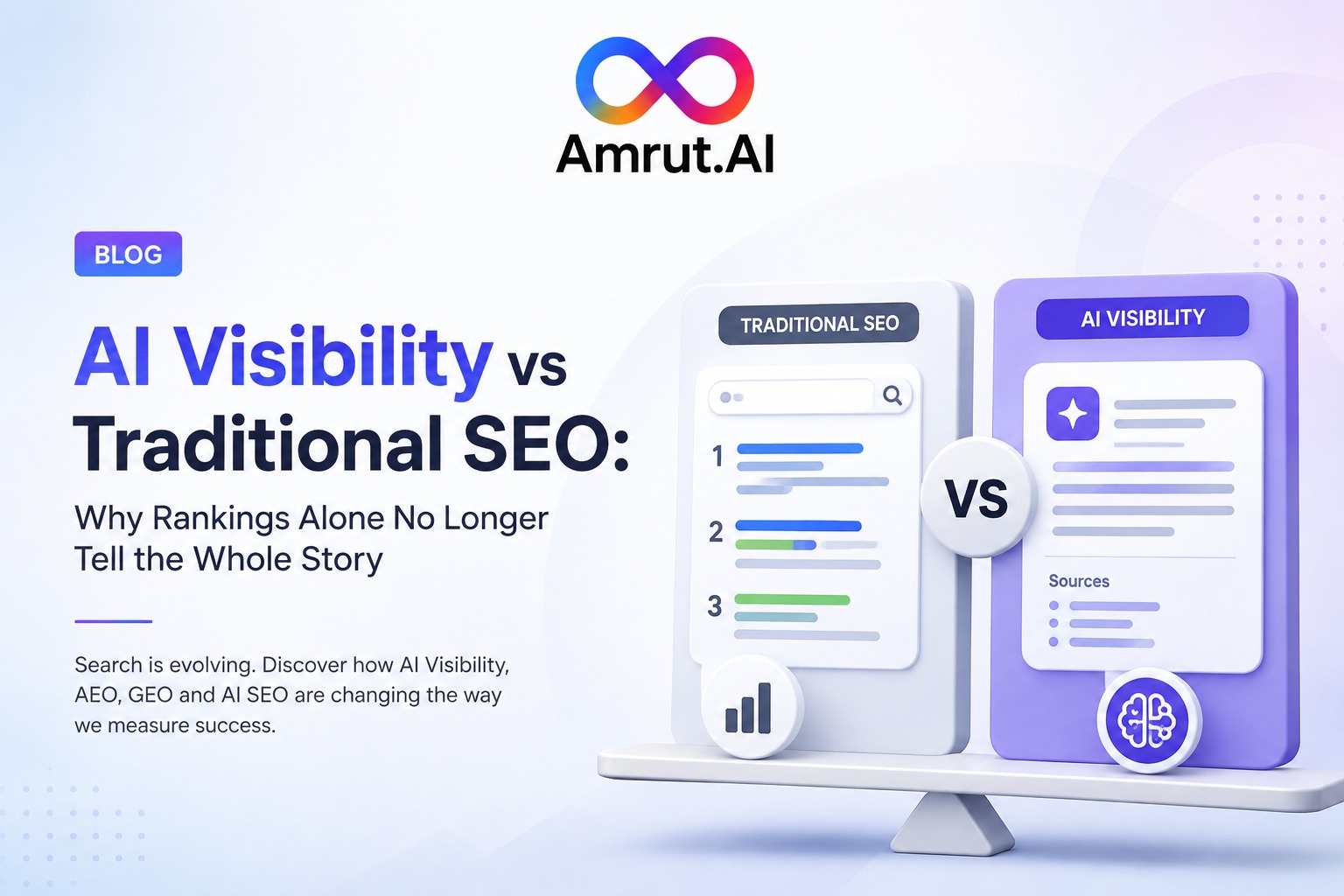
Amrut Ai
For years, SEO teams could answer a visibility question with a familiar dashboard: rankings, impressions, clicks, backlinks, and conversions. That still matters. But AI-generated search experiences now summarize answers, cite sources, mention brands without links, and sometimes satisfy the user before a click happens.
Google’s own guidance says its generative AI search features are still rooted in core Search systems, but they also use retrieval-augmented generation and query fan-out to synthesize answers from retrieved sources. In other words, SEO remains foundational, but the measurement layer has changed. (developers.google.cn)
This article explains how AI Visibility differs from traditional SEO, how AEO and GEO fit into modern AI SEO, and how to build a practical AI Visibility action plan using a GEO measurement model.
Key Definitions
SEO: Search Engine Optimization — improving a website’s technical accessibility, relevance, authority, and user value so it can perform in search results.
AEO: Answer Engine Optimization — optimizing content so it can be used in direct-answer environments such as featured snippets, AI answers, voice assistants, and conversational search.
GEO: Generative Engine Optimization — optimizing and measuring how content appears, is cited, or influences generative AI answers. The 2024 GEO research paper argued that visibility in generative engines is more nuanced than a simple rank because answers can include inline citations, variable source positions, and different degrees of source influence. (arxiv.org)
AI Visibility: A broader operating metric for whether your brand, pages, products, experts, and evidence appear in AI-generated answers, AI summaries, citations, recommendations, and downstream assisted journeys.
Why Rankings Alone Are No Longer Enough
Traditional SEO assumes a mostly linear journey:
- User searches.
- Search engine shows ranked links.
- User clicks.
- Website converts.
AI search breaks that pattern. A user may ask a long question, receive a synthesized answer, compare vendors inside the AI interface, and only later visit a site through direct, branded, paid, or referral traffic.
Pew Research Center analyzed browsing behavior from 900 U.S. adults and 68,879 Google searches in March 2025. In that dataset, 18% of Google searches generated an AI summary; users clicked a traditional result in 8% of visits with an AI summary versus 15% without one, and clicked a link inside the AI summary in only 1% of visits. The study is Google-only, U.S.-based, and time-bound, but it shows why click-based SEO reporting can understate AI influence. (pewresearch.org)
Semrush’s 2025 AI Overviews study also found that AI Overviews were volatile across the year: they appeared for 6.49% of tracked queries in January 2025, peaked near 24.61% in July, and settled at 15.69% in November. Its methodology used 10M+ keywords, plus smaller samples for query structure, zero-click trends, and industry analysis, so the findings are directional rather than universal. (semrush.com)
Traditional SEO Metrics vs AI Visibility Metrics
| Metric | What It Measures | Best For | Limitation | AI Visibility Interpretation |
| Keyword ranking | URL position in search results | Classic SEO performance | Does not show whether AI answers use or mention you | Still useful as a retrieval signal, not the whole story |
| Organic clicks | Visits from search | Traffic and revenue analysis | AI influence may occur without a click | Track, but combine with brand search, direct, and assisted journeys |
| Citations | Whether an AI answer links to your page | Source attribution | Citation count may not equal answer influence | Measure citation selection and citation quality |
| Answer-engine share | Share of brand mentions across prompt set | Competitive AI visibility | Depends heavily on prompt design | Useful for category-level AI share of voice |
| AI summary visibility | Presence in AI Overviews, AI Mode, or AI answers | SERP and answer visibility | Volatile by location, device, time, and prompt | Needs repeated measurement, not one-off screenshots |
| Citation absorption | Degree to which your content shapes the answer | Deeper GEO analysis | Hard to measure perfectly from outside the model | Use proxies: answer position, repeated references, semantic overlap, extracted facts |
A 2026 research paper on GEO measurement separates citation selection from citation absorption. In its dataset of 602 prompts across ChatGPT, Google AI Overview/Gemini, and Perplexity, citation breadth and citation depth diverged, suggesting that teams should not treat “number of citations” as the only AI visibility KPI. (arxiv.org)
Data-Backed Insight: AI Traffic Is Growing, but Attribution Is Messy
Similarweb estimated that AI platforms generated 1.13 billion referral visits to the top 1,000 websites in June 2025, up 357% year over year, but still far below 191 billion Google Search referrals in the same month. Similarweb’s methodology counts web referrals from AI platforms such as ChatGPT, Gemini, DeepSeek, Grok, Perplexity, Claude, and Liner, so it captures visible referral traffic, not all AI-influenced journeys. (similarweb.com)
Ahrefs analyzed 3,000 websites in February 2025 and found that 63% received at least one visit from an AI chatbot, but only 0.17% of average website visitors came from visible AI chatbot referrals. Ahrefs also noted that some AI-originated visits may appear as direct traffic, making visible AI referrals a minimum estimate. (ahrefs.com)
The practical takeaway: AI Visibility should not be judged only by last-click AI referrals. It should be measured across citations, mentions, prompts, summaries, brand demand, and assisted conversion signals.
The GEO Measurement Model: A Practical Framework
A useful GEO model should measure five layers:
1. Eligibility and Access
Before AI systems can cite or summarize your content, they must be able to access and understand it.
Check:
- Indexability and HTTP 200 status.
- Canonical URLs.
- Robots.txt rules.
- Meta robots and X-Robots-Tag.
- JavaScript rendering.
- Structured, readable HTML.
- Bot protection and WAF rules.
Google states that pages must be indexed and eligible to show snippets to appear in Google Search generative AI features; Google also says nosnippet applies to AI Overviews and AI Mode and prevents the page content from being used as direct input for those features. (developers.google.cn)
2. Retrieval and Citation Selection
Measure whether AI systems select your pages as sources.
KPIs:
- Citation rate by prompt cluster.
- Cited URL count.
- Source diversity.
- Competitor citation overlap.
- Prompt categories where competitors appear and you do not.
3. Answer Visibility and Absorption
Measure whether your content actually shapes the answer.
KPIs:
- Brand mention position.
- Citation position.
- Number of answer paragraphs influenced.
- Use of your definitions, statistics, comparisons, or steps.
- Sentiment and accuracy of brand description.
Because AI answers vary across runs, prompts, and time, repeated measurement is more reliable than a single manual test. A 2026 paper on measuring visibility in AI search argues that GEO performance should be treated as a distribution, not a one-time observation. (arxiv.org)
4. Competitive Answer-Engine Share
Measure your presence against competitors across the same prompt universe.
Formula example:
Answer-engine share = your brand mentions / total category brand mentions across tracked prompts
Segment by:
- Funnel stage.
- Country or region.
- Persona.
- Product category.
- AI platform.
- Branded vs non-branded prompts.
5. Business Impact
Measure whether AI visibility influences demand.
KPIs:
- AI referral traffic.
- Brand search lift.
- Direct traffic lift.
- Assisted conversions.
- Demo requests from “How did you hear about us?” fields.
- CRM source notes mentioning ChatGPT, Gemini, Perplexity, Google AI Overviews, or AI Mode.
Google now provides a Generative AI performance report in Search Console for eligible properties, including impressions from AI Overviews and AI Mode, though the report is being rolled out gradually and not all sites have access. (support.google.com)
Tool Landscape: Amrut.AI vs Common AI Visibility Platforms
The table below is not a ranking. It is a decision guide based on publicly available product descriptions and the product context provided for Amrut.AI.
| Option | Best For | Benefits | Limitations | Recommended Use Case |
| Amrut.AI | Teams wanting an AI Visibility action plan across SEO audits, AI data files, content, keywords, backlinks, competitors, analytics, and YouTube insights | Can serve as an operational hub for AI SEO workflows | Feature availability should be validated against the live product roadmap | Unified execution and reporting workflow |
| Semrush | Teams already using Semrush for SEO and competitive research | AI Visibility Score, share of voice, sentiment, competitor topics, and tracking across major AI/search experiences | Prompt limits vary by plan | SEO + AI visibility reporting in one suite (semrush.com) |
| Similarweb | Market intelligence and competitive visibility teams | Measures brand presence in generative AI platforms, topic visibility, competitors, sources, and prompts | Strongest when paired with analytics and SEO data | Category and competitor intelligence (support.similarweb.com) |
| Writesonic | Content and GEO workflow teams | Topic setup, prompt generation, AI visibility snapshots, multi-region monitoring | Content-led workflows may need separate technical SEO validation | GEO content planning and monitoring (docs.writesonic.com) |
| Peec.ai | Marketing teams focused on prompt monitoring | Tracks visibility, position, sentiment, and prompt-level insights | Public claims should be validated during evaluation | Lightweight AI search analytics (peec.ai) |
| Ahrefs | SEO teams wanting search-backed AI visibility research | Brand Radar tracks AI visibility across large prompt sets and shows citations, mentions, share of voice, and influencing channels | Ahrefs states its AI metrics are modeled visibility signals, not exact traffic counts | AI visibility plus backlinks, keywords, and web mentions (help.ahrefs.com) |
AI Visibility Implementation Guide
Timeline: 30–60 Days
Step 1: Define Prompt Clusters
Build 50–200 prompts across:
- Category discovery.
- Comparison prompts.
- “Best tool for…” prompts.
- Problem-solution prompts.
- Alternatives prompts.
- Technical integration prompts.
- YouTube and tutorial prompts.
Step 2: Audit Technical Access
Use your SEO crawler, Search Console, server logs, robots.txt, and CDN/WAF logs.
Also check AI crawler access. OpenAI’s publisher guidance says public websites can appear in ChatGPT search and recommends not blocking OAI-SearchBot if publishers want content included in summaries and snippets; it also distinguishes GPTBot as the user agent publishers can disallow for potential training exclusion. (help.openai.com)
Step 3: Build an Evidence-Rich Content Map
For every priority prompt, map:
- Best existing page.
- Missing comparison page.
- Missing technical guide.
- Missing pricing or integration explanation.
- Missing expert quote, original data, benchmark, or workflow.
Google’s guidance for generative AI search emphasizes useful, unique, people-first content and warns against low-value content created only to manipulate rankings or generative AI responses. (developers.google.cn)
Step 4: Measure Baseline AI Visibility
Track:
- Mention rate.
- Citation rate.
- Share of voice.
- Sentiment.
- Competitor co-mentions.
- Top cited third-party sources.
- AI Overview / AI Mode impressions where available.
Step 5: Publish and Strengthen Content
Prioritize:
- Clear definitions.
- Comparison tables.
- Original screenshots and product workflows.
- First-hand implementation notes.
- Cited data.
- Author and reviewer transparency.
- Schema where appropriate.
- Updated YouTube tutorials and transcripts.
Step 6: Review Monthly
Do not measure once. Re-run prompt panels monthly, compare distributions, and annotate major model, SERP, and content changes.
Industry-Specific Guidance
| Industry Segment | AI Visibility Priority | Operational Challenge | KPI |
| Digital marketing agencies | Client reporting beyond rankings | Explaining AI influence without overclaiming | AI share of voice, citations, assisted leads |
| SEO tools | Category and comparison prompts | Competitor co-mentions change quickly | Mention rate, competitor displacement |
| AI SEO audit tools | Technical access and content diagnostics | Separating crawl issues from content quality | Crawl pass rate, citation eligibility |
| LLM file generators / AI data files | Clear governance | Google says llms.txt is not needed for Google Search and is ignored by Google Search generative features | Adoption by non-Google systems, not Google ranking impact (developers.google.cn) |
| AI content generators | Trust and originality | Generic AI content can dilute E-E-A-T | Human-reviewed content, source quality |
| Keyword and ranking tools | Prompt-to-keyword mapping | AI prompts do not map perfectly to search volume | Prompt cluster coverage |
| Backlink monitoring | Authority and co-citation | Links alone do not guarantee AI citations | Referring domains plus AI citation rate |
| Competitor SEO and ads analysis | Category intelligence | AI Overviews increasingly overlap with commercial intent queries | Commercial prompt visibility (semrush.com) |
| Website analytics dashboards | Attribution | AI traffic may show as direct or dark social | AI referrals, direct lift, self-reported source |
| YouTube SEO insights | Multimedia answer visibility | AI systems may surface video or transcript-based evidence | YouTube mentions, video citations, branded searches |
Case Study: Illustrative Example
This is a hypothetical example, not a real customer case study.
A B2B SaaS company sells a privacy-focused website analytics dashboard. Its traditional SEO looks healthy: several top-five rankings, strong branded search, and steady backlinks. But an AI Visibility audit shows the brand is absent from prompts such as:
- “best privacy-friendly website analytics tools”
- “GA4 alternatives for SaaS founders”
- “analytics dashboard for GDPR-conscious startups”
- “best website analytics tool with YouTube traffic insights”
The team creates an AI Visibility action plan:
- Publish comparison pages with transparent criteria.
- Add a technical page explaining data collection and consent options.
- Create a YouTube walkthrough with transcript.
- Add expert-reviewed FAQs.
- Update robots and crawler access.
- Monitor 100 prompts monthly.
The goal is not to “game” AI systems. The goal is to make the brand easier to understand, cite, compare, and trust.
Common Mistakes
- Only tracking rankings: AI answers may mention or cite brands that do not rank first.
- Testing one prompt once: AI outputs vary.
- Overusing generic AI content: Thin summaries rarely add unique evidence.
- Blocking important crawlers unintentionally: Robots.txt, WAFs, CAPTCHAs, and JavaScript challenges can prevent access.
- Treating llms.txt as a Google ranking lever: Google says it does not use special AI text files for Google Search visibility. (developers.google.cn)
- Ignoring off-site sources: AI systems often rely on third-party pages, forums, YouTube, documentation, reviews, and reference sites.
AI Visibility Checklist
- Define priority prompt clusters.
- Track rankings, AI citations, AI mentions, and AI summaries.
- Segment prompts by funnel stage and persona.
- Verify crawlability, snippets, canonical tags, and robots rules.
- Add expert-reviewed, evidence-rich content.
- Build comparison and alternatives pages.
- Monitor competitor answer-engine share.
- Track AI referrals, direct traffic, brand search, and self-reported attribution.
- Review monthly, not once.
- Maintain legal review for privacy, copyright, and regulated claims.
Compliance note: this article is educational and not legal advice. For privacy, copyright, advertising, or regulated-industry questions, consult qualified counsel.
FAQs
Is SEO dead because of AI search?
No. Google states that SEO best practices remain relevant for generative AI features because those features are rooted in Search systems. But SEO reporting now needs AI visibility metrics in addition to rankings and clicks. (developers.google.cn)
What is the difference between AEO and GEO?
AEO focuses on answer visibility generally. GEO focuses specifically on generative engines that synthesize answers, cite sources, and may use content without producing a traditional click.
What should I measure first?
Start with five metrics: prompt coverage, brand mention rate, citation rate, competitor share of voice, and AI-assisted conversions.
Do backlinks still matter?
Yes, but not as a standalone AI visibility metric. Links can support authority and discovery, while AI visibility also depends on structure, evidence, clarity, entity recognition, and source selection.
Should I create an llms.txt file?
It may be useful for systems that choose to read it, but Google says it is not needed for Google Search and is ignored by Google Search generative AI features. Treat it as optional infrastructure, not a guaranteed visibility lever. (developers.google.cn)
Conclusion
Traditional SEO answers the question: “Where do we rank?”
AI Visibility answers a broader question: “When AI systems explain, compare, recommend, or cite solutions in our category, are we present, accurate, trusted, and influential?”
The winning strategy is not to abandon SEO. It is to extend SEO into a measurable GEO and AEO discipline: keep your site technically accessible, create evidence-rich content, monitor AI summaries and citations, compare against competitors, and connect visibility to business outcomes.
For teams using Amrut.AI, the opportunity is to turn AI Visibility from a vague trend into a structured operating system: audit, measure, prioritize, publish, monitor, and improve.
Sources and References
- Google’s Guide to Optimizing for Generative AI Features on Google Search — Google Search Central. Relevant for Google’s official position on SEO, AI Overviews, AI Mode, RAG, query fan-out, and llms.txt. Accessed August 15, 2026. (developers.google.cn)
- Generative AI Performance Report — Google Search Console Help. Relevant for measuring Google AI Overviews and AI Mode impressions. Accessed August 15, 2026. (support.google.com)
- Robots Meta Tags Specifications — Google Search Central. Relevant for nosnippet, X-Robots-Tag, and AI Overviews / AI Mode snippet controls. Accessed August 15, 2026. (developers.google.com)
- Publishers and Developers FAQ — OpenAI Help Center. Relevant for OAI-SearchBot, GPTBot, and ChatGPT referral tracking. Accessed August 15, 2026. (help.openai.com)
- RFC 9309: Robots Exclusion Protocol — IETF / RFC Editor. Relevant for robots.txt as the standardized crawler access protocol. (rfc-editor.org)
- GEO: Generative Engine Optimization — Aggarwal et al., ACM KDD / arXiv, 2024. Relevant foundational GEO research and visibility metrics. (arxiv.org)
- Google Users Are Less Likely to Click on Links When an AI Summary Appears — Pew Research Center, July 22, 2025. Relevant user-behavior study with sample size and methodology. (pewresearch.org)
- Semrush AI Overviews Study — Semrush, December 15, 2025. Relevant industry dataset on AI Overview prevalence and intent shifts. (semrush.com)
- AI Overviews Are Expanding Across Commercial Intent Search — Semrush, July 2, 2026. Relevant for commercial-intent AI Overview trends. (semrush.com)
- AI Referral Traffic Winners by Industry — Similarweb, July 29, 2025. Relevant for AI referral traffic scale and methodology. (similarweb.com)
- 63% of Websites Receive AI Traffic — Ahrefs, February 6, 2025. Relevant for visible AI referral traffic benchmarks and limitations. (ahrefs.com)
- From Citation Selection to Citation Absorption — Zhang, He, and Yao, arXiv, April 2026. Relevant for measuring citation depth, not just citation count. (arxiv.org)