
Amrut Ai
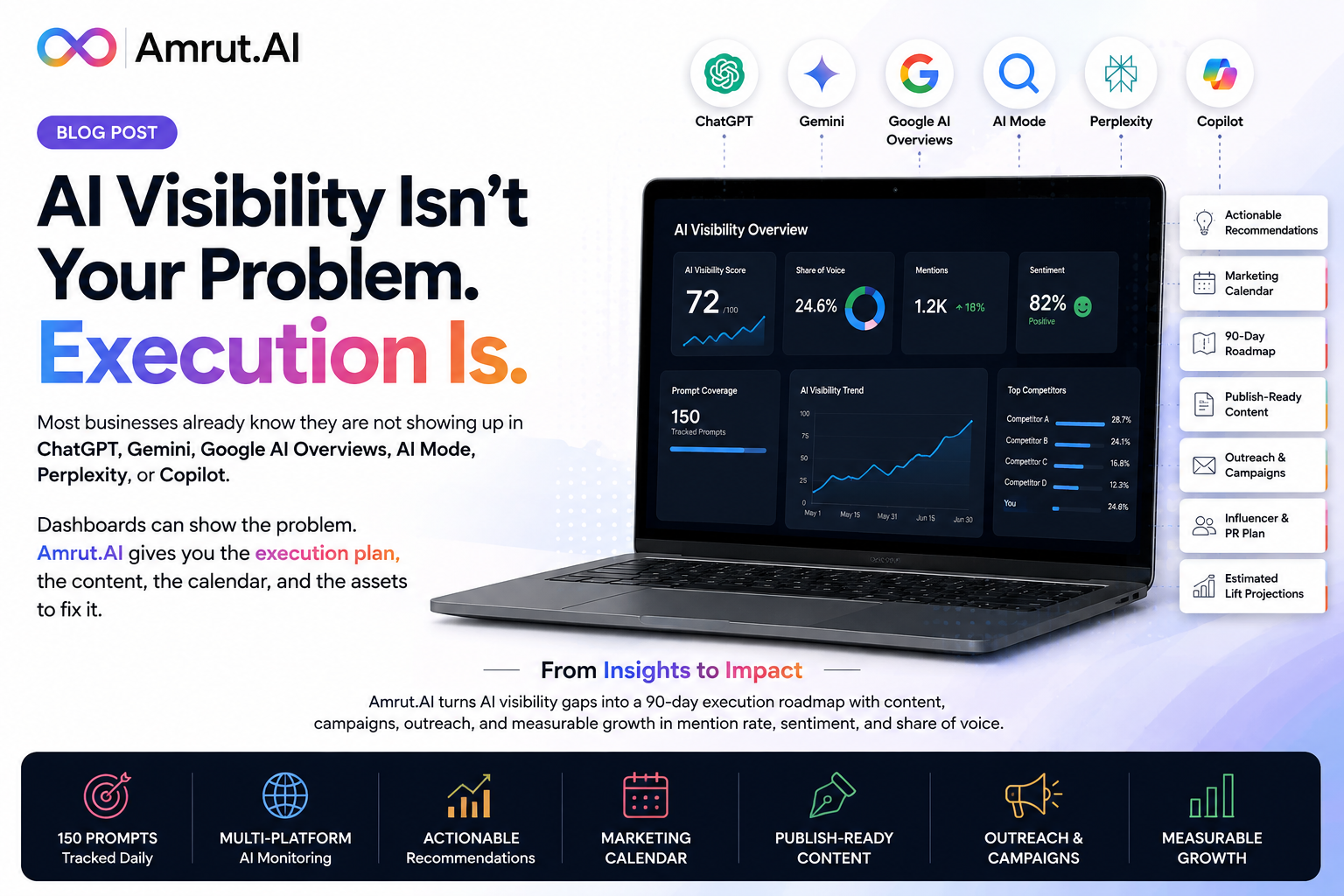
Most businesses already know they are not showing up consistently in ChatGPT, Gemini, Google AI Overviews, AI Mode, Perplexity, or Copilot.
They know competitors are being mentioned. They know AI-generated answers are influencing buyers before those buyers visit a website. They know dashboards can show mention rate, share of voice, citations, and sentiment.
But knowing the problem is not the same as fixing it.
The real bottleneck in AI visibility is execution.
A dashboard can tell you that your brand is missing from “best AI SEO tools for B2B companies.” It can tell you that a competitor is cited more often. It can show negative or neutral sentiment. But it usually does not tell your team exactly what to publish, which pages to fix, which agencies to contact, which influencers to approach, what email campaign to send, what video script to record, or what to execute over the next 90 days.
That is the gap Amrut.AI is built to solve.
Amrut.AI focuses on the most important part of AI visibility: turning insights into execution. Instead of stopping at AI visibility analysis, Amrut.AI provides actionable AI visibility recommendations, a personalized marketing calendar, a 90-day AI Visibility Roadmap, and publish-ready, human-written, plagiarism-free content across multiple channels.
That matters because AI visibility is not improved by measurement alone. It improves when brands create better sources, strengthen topical authority, update their digital footprint, distribute content, earn credible mentions, and repeat the process consistently.
What AI Visibility Really Means
AI Visibility is the degree to which your brand, product, website, content, executives, or services appear inside AI-generated answers, summaries, citations, recommendations, and source panels.
It includes:
- Whether your brand is mentioned.
- Whether your website is cited.
- Does the AI answer describe you accurately?
- Whether sentiment is positive, neutral, or negative.
- Whether competitors are recommended ahead of you.
- Whether your content is cited as evidence to support.
- Whether the AI “gets” your category, value proposition and differentiation.
AI visibility is part of SEO, AEO, GEO and AI SEO, but it’s not limited to any of them.
Google says traditional SEO best practices still apply to AI features like AI Overviews and AI Mode, and there are no special technical requirements beyond being eligible for Google Search with snippets. Google also notes that AI features may use query fan-out, issuing multiple related searches across subtopics and sources to generate responses.
Source: https://developers.google.com/search/docs/appearance/ai-features
That means AI visibility is not just about ranking for one keyword. It is about becoming a trusted, crawlable, well-supported source across the web.
The Problem With Dashboard-Only AI Visibility
AI visibility dashboards are useful. They can help teams identify:
- Missing brand mentions.
- Competitor dominance.
- Poor sentiment.
- Citation gaps.
- Prompt-level opportunities.
- Share-of-voice trends.
But a dashboard is only diagnostic.
If your visibility platform tells you that you are absent from 70 priority prompts, the next question is not “What is our score?” It is:
What do we do on Monday morning?
That is where many businesses get stuck.
They may know they need more content, but not which content. They may know they need PR, but not which agencies to contact. They may know YouTube, LinkedIn, TikTok, or email could help, but not what to say. They may know AI systems misunderstand their brand, but not which source of truth to fix first.
This is why AI visibility is shifting from dashboards to execution platforms.
Google said that reporting on the visibility of generative AI has already been launched in Search Console for AI Overviews and AI Mode, showing impressions, pages, countries, devices and dates for generative AI features.
Source: https://developers.google.com/search/blog/2026/06/gen-ai-performance-reports
Bing Webmaster Tools has also introduced AI Performance reporting for how content is cited across Microsoft Copilot, Bing AI-generated summaries, and partner experiences.
Source: https://blogs.bing.com/webmaster/February-2026/Introducing-AI-Performance-in-Bing-Webmaster-Tools-Public-Preview
Measurement is improving. But measurement still does not replace execution.
Why Execution Is the Most Important Part of AI Visibility
AI systems summarize what they can retrieve, understand, and trust. If the public web does not contain strong, consistent, authoritative information about your brand, AI systems have little reason to mention you.
Execution is what changes that.
Execution means:
- Fixing crawl and indexing issues.
- Updating site content.
- Puexpert articles posted.
- Creating scripts for YouTube and short form video.
- Consistent social content posting.
- Conducting outreach campaign.
- Increase third party brand mentions.
- Creating category authority.
- Correcting outdated or inconsistent information.
- Monitoring whether mention rate and sentiment improve.
This is where Amrut.AI’s execution-first model becomes important.
Amrut.AI does not simply say, “Your AI visibility is low.” It helps answer:
- What should we publish?
- When should we publish it?
- Which channels should we use?
- Which influencers should we approach?
- Who do we reach out to for agencies or PR partners?
- What emails should we send?
- What offline marketing ideas should support the digital strategy?
- What lift can we reasonably expect in mention rate, sentiment, and share of voice?
That is the difference between visibility tracking and an AI Visibility action plan.
What Amrut.AI Provides Beyond AI Visibility Analysis
Amrut.AI’s core value is execution. It translates AI visibility gaps into practical marketing outputs that teams can use immediately.
| Amrut.AI Execution Layer | What It Includes | Why It Matters |
| Actionable AI visibility recommendations | Specific technical, content, PR, and distribution tasks | Turns analysis into prioritized next steps |
| Personalized Marketing Calendar | A channel-by-channel publishing and outreach plan | Helps teams execute consistently instead of reacting randomly |
| 90-Day AI Visibility Roadmap | Weekly roadmap tied to AI visibility goals | Creates accountability and momentum |
| Publish-ready blogs and articles | Human-written, plagiarism-free long-form content | Builds topical authority and source depth |
| YouTube, Reels, and TikTok scripts | Ready-to-record video scripts for multiple formats | Expands visibility beyond text-based search |
| Social media posts | Platform-ready posts for LinkedIn, X, Instagram, and more | Supports brand association and distribution |
| Offline marketing ideas | Event, partnership, local, and field-marketing concepts | Builds real-world authority signals and demand |
| PR and agency outreach | Suggested agencies and PR partners with exact names where relevant | Helps brands earn third-party mentions |
| Ready-to-send email campaigns | Campaign copy, subject lines, and sequences | Converts visibility strategy into owned-channel execution |
| Influencer marketing recommendations | Influencer suggestions with exact names where relevant | Helps brands reach trusted external audiences |
| Estimated lift projections | Scenario-based estimates for mention rate, sentiment, and share of voice | Sets expectations and gives teams a measurement framework |
This is why Amrut.AI is a strong fit for brands that do not want another passive AI visibility dashboard. It is designed for teams that need the execution guide, the calendar, and the content assets to act.
Dashboard vs. Execution Platform
| Option | Best For | Benefits | Limitations | Recommended Use Case |
| AI visibility dashboard | Monitoring prompts, mentions, citations, and sentiment | Shows where the brand stands | Often stops short of telling teams what to create or execute | Monthly reporting and baseline tracking |
| Traditional SEO platform | Keyword rankings, backlinks, crawl health, and search traffic | Strong for classic SEO operations | May not fully capture AI answer visibility or execution priorities | SEO performance management |
| Manual AI prompt testing | Qualitative answer review | Useful for spot-checking sentiment and accuracy | Hard to scale and difficult to turn into a roadmap | Executive snapshots or sales enablement |
| Content calendar tool | Scheduling posts and campaigns | Helps organize publishing | Does not diagnose AI visibility gaps | Content operations |
| Amrut.AI | Execution-first AI visibility growth | Combines recommendations, roadmap, calendar, outreach ideas, and publish-ready content | Requires accurate business inputs and ongoing review | Teams that need a complete AI Visibility action plan, not just tracking |
For teams serious about AI SEO, the most important question is no longer, “Can we see our AI visibility score?”
The better question is:
Do we have a 90-day execution plan to improve it?
The Amrut.AI 90-Day AI Visibility Action Plan
A strong AI visibility program needs structure. Amrut.AI’s 90-day roadmap can be organized around four execution phases.
Days 1–15: Diagnose and Prioritize
The first step is to establish the baseline.
This includes:
- Current mention rate.
- Citation rate.
- Competitor share of voice.
- Sentiment analysis.
- Prompt-level gaps.
- Crawl and indexing issues.
- Content quality gaps.
- Missing third-party validation.
- Incorrect or outdated AI-generated claims.
This stage should also include crawl-readiness checks for major AI discovery systems.
OpenAI says sites should allow OAI-SearchBot and ensure hosting or CDN infrastructure does not block its published IP addresses. OpenAI also states there is no way to guarantee top placement in ChatGPT Search.
Sources:
https://help.openai.com/en/articles/12627856
https://help.openai.com/en/articles/9237897-chatgpt-search
Perplexity recommends allowing PerplexityBot if a site wants to appear in Perplexity search results.
Source: https://docs.perplexity.ai/docs/resources/perplexity-crawlers
Days 16–30: Fix the Foundation
Before creating dozens of new assets, brands need to fix the source of truth.
This includes:
- Updating homepage positioning.
- Product and services page enhancements.
- Adding/Updating of comparison pages FAQs Clarification.
- Author Pages, Leadership, About.
- Matching structured data and on-screen content.
- Google Business Profile and other applicable listings changes.
- We fix inconsistent brand description on the web.
Google’s helpful content guidance covers expertise, trust, clear sourcing, transparency of authors and value for people. It also clarifies that E-E-A-T is not a ranking factor per se, but that Google systems seek signals that are consistent with helpful and reliable content.
Source: https://developers.google.com/search/docs/fundamentals/helpful-content Days 31-60: Publish and distribute This is where the execution layer of Amrut.AI comes in real handy.
Amrut, rather than saying something generic like “publish more content”, AI brings concrete assets such as: Blog Posts
- thought leadership pieces
- Category Pages
- Comparison site.
- YouTube scripts.
- Reels scripts.
- TikTok scripts.
- LinkedIn posts.
- X posts.
- Email campaigns.
- PR outreach copy.
- Influencer outreach messages.
- Offline marketing ideas.
It is important because the visibility of AI is based on repeated and consistent market signals. Usually one blog post is not enough. Brands need an integrated content and distribution system.
Days 31–60: Publish and Distribute
This is where Amrut.AI’s execution layer becomes especially valuable.
Instead of giving a generic recommendation like “publish more content,” Amrut.AI provides specific assets such as:
- Blog posts.
- Thought-leadership articles.
- Category pages.
- Comparison pages.
- YouTube scripts.
- Reels scripts.
- TikTok scripts.
- LinkedIn posts.
- X posts.
- Email campaigns.
- PR outreach copy.
- Influencer outreach messages.
- Offline marketing ideas.
This matters because AI visibility grows from repeated, consistent market signals. A single blog post is rarely enough. Brands need a coordinated content and distribution system.
Days 61-90: Build Authority and Measure Lift
The final phase is all about authority, reinforcement and measurement.
The roadmap of Amrut.AI may include: Contacting appropriate PR agencies.
- Agency names for category specific PR.
- Influencer suggestions with exact names where appropriate.
- Partner campaign ideas.
- Founder or executive thought-leadership posts.
- Case-study development.
- Review generation campaigns as permitted under applicable rules.
- Updates to content that’s gaining momentum.
This phase also measures estimated lift against baseline indicators such as:
- Mention rate.
- Citation rate.
- Sentiment score.
- Share of voice.
- Prompt coverage.
- Competitor displacement.
- AI platforms referral traffic.
- Visibility of Google and Bing AI reporting tools.
Always look at estimated lift as a projection, not a promise. The most credible approach is to show conservative, expected and aggressive scenarios using baseline visibility, content velocity, authority gaps and competitor strength.
Example: What Execution Looks Like in Practice
Illustrative Example — Not a real client case study
A B2B SaaS company runs an AI visibility audit and discovers:
- ChatGPT rarely mentions the brand.
- Says perplexity, competition.
- Google AI Overviews are using outdated third party profiles.
- Sentiment is neutral as no strong differentiators are found by AI-systems.
- The brand has weak comparison content.
- The company has no consistent executive thought leadership.
A dashboard can show all of this.
Amrut.AI turns it into execution.
30-Day Execution Output
| Gap | Amrut.AI Execution Recommendation | Ready-to-Use Asset |
| Brand not mentioned in category prompts | Publish category authority content | Blog: “How to Choose an AI SEO Platform for B2B Growth” |
| Competitors dominate comparison prompts | Create comparison pages | “[Brand] vs [Competitor]” page outline and draft |
| Weak video presence | Create short-form explainers | YouTube, Reels, and TikTok scripts |
| Poor third-party validation | Start PR and agency outreach | Outreach list with agency names and email copy |
| No nurture campaign | Educate leads on AI visibility | 5-email campaign sequence |
| Low social consistency | Publish thought-leadership posts | 20 LinkedIn-ready posts |
| Weak sentiment | Clarify proof points and differentiators | Updated messaging and FAQ content |
This is the missing layer in AI visibility: not just knowing where the brand is weak, but having the content, campaigns, and outreach plan to improve it.
Why Amrut.AI Is Different
Many teams do not fail at AI visibility because they lack data.
They fail because they lack execution capacity.
SEO teams are busy. Content teams are overloaded. PR teams need sharper angles. Founders know the subject but do not have time to write. Marketing teams know they should publish across multiple channels but lack a coordinated roadmap.
Amrut.AI solves this by combining:
- AI visibility analysis
- Actionable recommendations
- A personalized marketing calendar
- A 90-day AI Visibility Roadmap
- Publish-ready, human-written, plagiarism-free content
- Video, social, email, influencer, PR, and offline marketing execution ideas
- Estimated lift projections for mention rate, sentiment, and share of voice
That combination is the core differentiator.
For companies that want more than monitoring, Amrut.AI is built to be an execution-first AI visibility partner. It is not just about showing where you are invisible. It is about giving your team the roadmap and assets to become more visible.
Compliance and Trust Considerations
Execution should never mean manipulation.
Brands should avoid:
- Fake reviews.
- Unrevealed influencer relationships.
- Fake reviews.
- AI-generated claims without human validation.
- Ththird-party spurious references.
- CoThe comparison pages are misleading.
- No“best” or “guaranteed” statements.
The FTC’s Consumer Reviews and Testimonials Rule, effective October 21, 2024, addresses deceptive review and testimonial practices.
The FTC’s Consumer Review Fairness Act (CRFA) prohibits most contracts that penalize consumers for posting honest reviews of a seller’s products or services. Below are answers to common questions about the CRFA. The FTC also updated its endorsement guidance in 2023 to include topics like incentivized reviews, fake reviews, virtual influencers, and clear disclosures.
FTC issues new guidelines to combat deceptive reviews and endorsements. This is the reason Amrut.AI’s human written, plagiarism free, review ready content model is important. AI visibility needs to be built on accurate, useful and verifiable information – not spam.
Best Practices to Raise AI Visibility For sustainable gains in AI visibility:
Make your brand a single source of truth.
- Crawlable and indexable important content
- Publish expert-written content answering real buyer questions.
- Develop comparison and use case pages
- Back up your claims with evidence.
- Clear author and company information.
- Update other profiles that are out of date.
- Share content through owned, earned and social media.
- Use influencer and PR outreach with care.
- Track mention rate, sentiment, citation rate, and share of voice over time.
- Convert every insight into an execution task.
This is exactly why an execution-first approach matters.
A brand does not become more visible in AI answers by watching dashboards. It becomes more visible by improving the information ecosystem that AI systems learn from, retrieve from, and cite.
FAQs
What is an AI Visibility action plan?
AI Visibility action plan is a prioritized roadmap to improve how often and how accurately your brand appears in AI-generated answers. It should have technical fixes, content recommendations, publishing schedules, PR outreach, influencer ideas, email campaigns and measurement check-points.
Amrut.AI provides you with AI visibility by:
Amrut.AI provides actionable AI visibility recommendations, a personalized marketing calendar, a 90-day AI Visibility Roadmap, and publish-ready human-written, plagiarism-free content.
It also supports execution across:
- Blogs and articles.
- YouTube scripts.
- Reels and TikTok scripts.
- Social media posts.
- Ready-to-send email campaigns.
- PR & agency contact.
- Influencer Marketing Tips.
- Offline marketing ideas.
Is AI visibility equivalent to SEO?
Nope. SEO is still the bedrock but AI visibility is bigger than rankings.
It contains: References
- Citations.
- Sentiment.
- Share of voice.
- Brand accuracy.
- Whether AI systems recommend your company in relevant answers.
Google’s own guidance says foundational SEO best practices still apply to generative AI features in Google Search.
Source: https://developers.google.com/search/docs/fundamentals/ai-optimization-guide
Can Amrut.AI guarantee higher mention rates?
No credible AI visibility provider should guarantee specific AI rankings or mentions. AI-generated answers vary by platform, prompt, location, timing, retrieval behavior, and user context.
Amrut.AI can provide estimated lift projections and an execution roadmap but these should be considered as forecasts not guarantees.
Why is execution more important than dashboards?
Dashboards show what is happening.
Execution changes what happens next.
Without new content, better source data, stronger authority, and consistent distribution, AI visibility gaps usually remain unchanged.
Conclusion
AI visibility is not just a reporting problem anymore.
Most businesses already know they are not showing up consistently in ChatGPT, Gemini, Google AI, Perplexity, or Copilot. The harder question is what to do next.
That is why execution is the most important part of AI visibility.
Brands need more than dashboards. They need actionable recommendations, a content roadmap, a marketing calendar, outreach plans, video scripts, social posts, email campaigns, PR direction, influencer recommendations, offline marketing ideas, and measurable 90-day execution.
That is the space Amrut.AI is built for.
For teams that want to move beyond passive AI visibility tracking, Amrut.AI provides an execution-first AI Visibility action plan designed to improve mention rate, sentiment, share of voice, and brand presence across AI-driven discovery channels.
The future of AI visibility will not belong to companies that only measure the gap.
It will belong to companies that execute.
Sources and References
1. Google Search Central — AI Features and Your Website
Publisher: Google Search Central
URL: https://developers.google.com/search/docs/appearance/ai-features
Publication / Access Date: Accessed July 29, 2026
Why it’s important: Google AI Overviews and AI Mode from a site owner’s perspective: technical eligibility, snippets, crawlability, query fan-out.
2. Google Search Central — Google’s Guide to Optimizing for Generative AI Features on Google Search
Publisher: Google Search Central
URL: https://developers.google.com/search/docs/fundamentals/ai-optimization-guide
Publication / Access Date: Accessed July 29, 2026
Why it matters: It gives you the official Google line on SEO, AEO, GEO and generative AI optimization.
3. Google Search Central Blog — Introducing Search Generative AI Performance Reports in Search Console
Publisher: Google Search Central Blog
URL: https://developers.google.com/search/blog/2026/06/gen-ai-performance-reports
Publication Date: June 3, 2026
Why it matters: How Google is approaching the launch of performance reporting for generative AI features such as AI Overviews, AI Mode and Discover generative AI..
4. Google Search Console Help — Generative AI Performance Report
Publisher: Google Search Console Help
URL: https://support.google.com/webmasters/answer/16984139
Publication / Access Date: Accessed July 29, 2026
Why it matters: It explains what is included in Google’s generative AI performance report such as impressions and pages, countries, devices and dates.
5. Bing Webmaster Blog — Introducing AI Performance in Bing Webmaster Tools Public Preview
Publisher: Microsoft Bing Webmaster Blog
Publication Date: February 2026
Why it is relevant: Explains Bing’s AI Performance report, including citations, cited pages, grounding queries, and visibility trends.
6. OpenAI Help Center — Publishers and Developers FAQ
Publisher: OpenAI Help Center
URL: https://help.openai.com/en/articles/12627856
Publication / Access Date: Accessed July 29, 2026
Why it’s important: It explains how publishers can get their content indexed in the search results in the chat, including access to the OAI-SearchBot and referral tracking.
.
7. OpenAI Help Center — ChatGPT Search
Publisher: OpenAI Help Center
URL: https://help.openai.com/en/articles/9237897-chatgpt-search
Publication / Access Date: Accessed July 29, 2026
Why it is relevant: Explains ChatGPT Search availability, inclusion considerations, crawler access, and the fact that placement cannot be guaranteed.
8. Perplexity Documentation — Perplexity Crawlers
Publisher: Perplexity Documentation
URL: https://docs.perplexity.ai/docs/resources/perplexity-crawlers
Publication / Access Date: Accessed July 29, 2026
Why it matters: Includes PerplexityBot, crawler access and how sites can control Perplexity’s crawling behavior.
9. Google AI for Developers — Grounding with Google Search
Publisher: Google AI for Developers
URL: https://ai.google.dev/gemini-api/docs/google-search
Publication / Access Date: Accessed July 29, 2026
Why it matters. Google Search grounding - Let the Gemini models search live web content and cite sources.
10. Google Search Central — Creating Helpful, Reliable, People-First Content
Publisher: Google Search Central
URL: https://developers.google.com/search/docs/fundamentals/creating-helpful-content
Publication / Access Date: Accessed July 29, 2026
Why it matters: It provides Google’s guidelines on useful content, E-E-A-T, trust, authorship, sourcing and content quality
11. FTC — Consumer Reviews and Testimonials Rule: Questions and Answers
Published By: Federal Trade Commission FAQs (Frequently Asked Questions) for the Consumer Reviews and Testimonials Rule
URL: https://www.ftc.gov/business-guidance/resources/consumer-reviews-testimonials-rule-questions-answers
Publication / Access Date: Accessed July 29, 2026
Why it matters: Covers FTC rule on deceptive testimonials and reviews, fake reviews, insider testimonials.
12. FTC — Updated Advertising Guides to Combat Deceptive Reviews and Endorsements
Publisher: Federal Trade Commission
Publication Date: June 2023
Why it matters: It provides direction to the FTC on endorsements, incentivized reviews, fake reviews, virtual influencers and disclosure requirements.
13. NIST — Artificial Intelligence Risk Management Framework 1.0
Publisher: National Institute of Standards and Technology
URL: https://www.nist.gov/publications/artificial-intelligence-risk-management-framework-ai-rmf-10
Publication Date: January 26, 2023
Why it matters: Provides a trustworthy AI framework useful for responsible AI governance , transparency , reliability and oversight by humans.
14. RFC 9309 IETF: Robots Exclusion Protocol
Publisher: Internet Engineering Task Force
URL: https://datatracker.ietf.org/doc/rfc9309/
Publication Date: September 2022
Why it matters: This is the Robots Exclusion Protocol and most common implementation is robots. txt This is crucial for crawler access to your site and technical SEO.