
Amrut Ai
AI visibility is now a measurable part of SEO. Your buyer may ask ChatGPT for “best SEO audit tools,” use Perplexity to compare vendors, ask Gemini for implementation advice, or see a Google AI Overview before clicking a traditional result. In each case, the brand that gets mentioned, cited, and framed positively has an advantage before the buyer ever reaches a website.
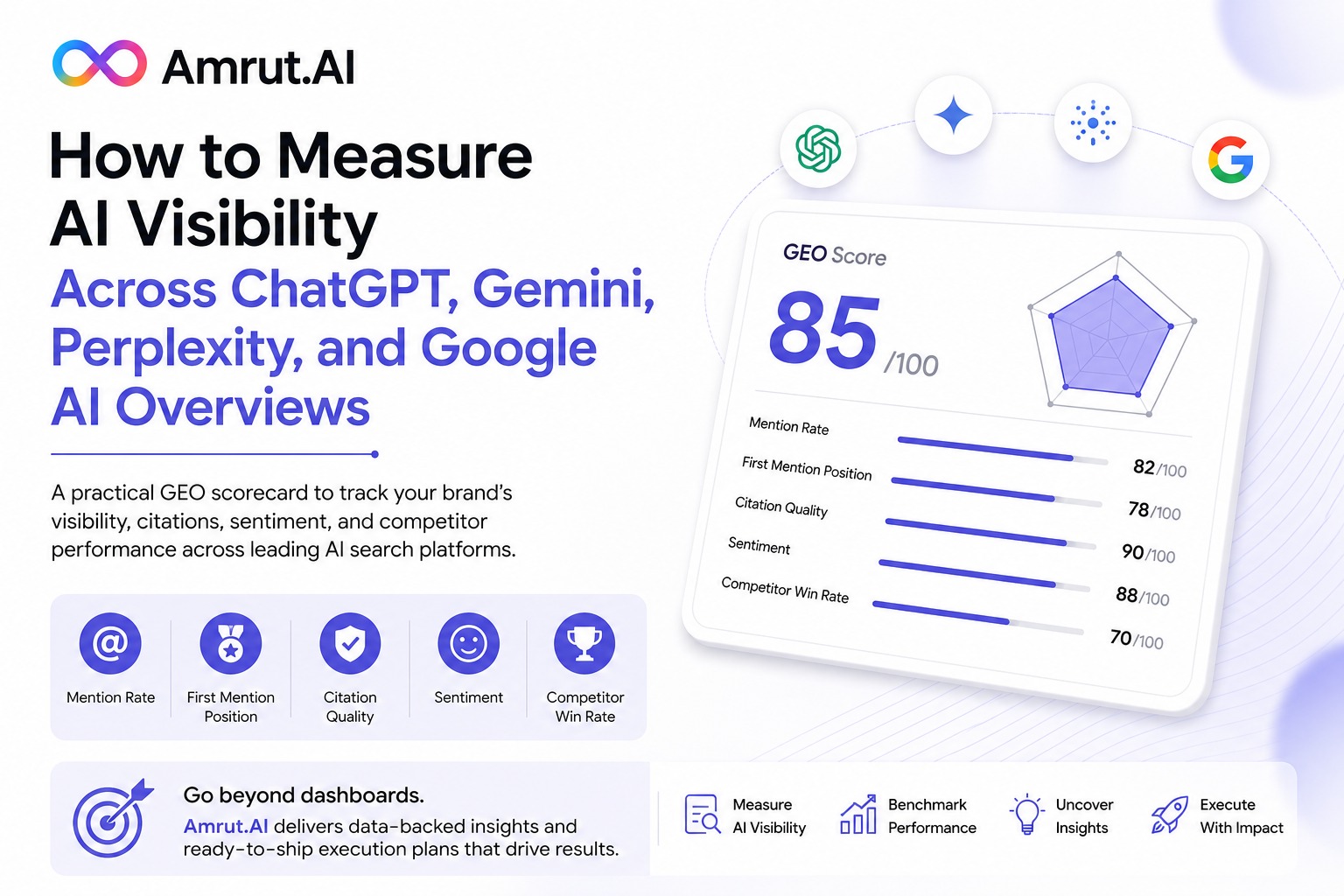
This article introduces a practical GEO scorecard for measuring AI visibility across ChatGPT, Gemini, Perplexity, and Google AI Overviews. The framework focuses on five metrics: mention rate, first mention position, citation quality, sentiment, and competitor win rate. It also explains how Amrut.ai differentiates itself by moving beyond visibility dashboards into ready-to-ship execution plans.
As of July 28, 2026, AI search measurement is still evolving. ChatGPT Search can show inline citations and a Sources panel, Gemini’s grounded API can return URL citation annotations, Perplexity describes itself as a real-time answer engine with citations, and Google now provides dedicated Search Console reporting for generative AI features such as AI Overviews and AI Mode. (help.openai.com)
Key Definitions: SEO, AEO, GEO, and AI SEO
SEO is the practice of improving crawlability, relevance, authority, and user experience so pages can rank in search engines.
AEO, or Answer Engine Optimization, focuses on getting your brand, data, and content selected inside direct answers, not just ranked as a blue link.
GEO, or Generative Engine Optimization, is the practice of improving how generative systems retrieve, cite, synthesize, and recommend your brand. The term was formalized in academic work on “Generative Engine Optimization,” which framed visibility inside generative responses as a new optimization problem for content creators. (arxiv.org)
AI SEO is the operational layer that combines traditional SEO, structured content, entity accuracy, citation-building, AI visibility tracking, and execution workflows for AI-mediated discovery.
The important point: AEO and GEO do not replace SEO. They extend it. Google’s documentation says that to appear as a supporting link in AI Overviews or AI Mode, a page must be indexed and eligible to appear in Google Search with a snippet. (developers.google.com)
Why AI Visibility Needs Its Own Scorecard
Traditional SEO answers questions like:
- Do we rank?
- How much organic traffic did we receive?
- Which pages are converted?
AI visibility asks different questions:
- Were we mentioned at all?
- Were we mentioned before competitors?
- Were we cited from a credible source?
- Did the AI describe us accurately?
- Did the AI recommend a competitor instead?
Recent research also shows why one-off screenshots are unreliable. A 2026 paper on GEO measurement argues that visibility should be measured repeatedly because AI outputs vary across prompts, systems, and time. (arxiv.org) Another 2026 GEO measurement paper separates citation selection from citation absorption—meaning a source can be retrieved, cited, or actually used to shape the answer in different ways. (arxiv.org)
That is why a practical AI visibility program needs a scorecard, not a vanity metric.
The Practical GEO Scorecard
Use the following five metrics as your baseline.
| Metric | What It Measures | Formula / Scoring Method | Why It Matters |
| Mention Rate | How often your brand appears in AI answers | Brand mentions ÷ total measured responses | Measures baseline visibility |
| First Mention Position | Where your brand appears when multiple brands are listed | Average rank position or % of top-1 / top-3 mentions | Captures prominence, not just presence |
| Citation Quality | Whether citations supporting your brand are reliable, relevant, current, and independent | 0–5 rubric based on source type, topical relevance, freshness, authority, and factual alignment | Weak citations can create fragile visibility |
| Sentiment | How positively, neutrally, or negatively the AI describes your brand | Positive, neutral, negative, mixed, or numeric score from -2 to +2 | Visibility is not useful if the narrative is wrong |
| Competitor Win Rate | How often a competitor beats you in the answer | Competitor wins ÷ total category responses | Shows whether your GEO problem is awareness, positioning, or authority |
Recommended GEO Score Formula
Use a 100-point score:
GEO Score =
(Mention Rate x 30)
+ (First Mention Position Score x 20)
+ (Citation Quality Score x 25)
+ (Sentiment Score x 15)
+ ((1 - Competitor Win Rate) x 10)
This is not an industry standard. It is a practical operating model. A 2026 critical survey of GEO research notes that terminology, metrics, and evidence standards remain inconsistent across the field, so teams should document their own scoring assumptions. (arxiv.org)
How to Measure Each AI Search Surface
| Platform / Surface | Best For | What to Track | Measurement Notes |
| ChatGPT / ChatGPT Search | Conversational vendor discovery, comparisons, implementation questions | Mentions, citations, source panel links, sentiment, competitor ordering | ChatGPT Search responses may include inline citations and a Sources panel; OpenAI also advises users to verify important information. (help.openai.com) |
| Gemini | Google-connected research, Workspace-style advice, search-grounded answers | Mentions, related sources, grounded citations where available, factual accuracy | Gemini Apps can be inaccurate and Google advises users to double-check responses; Gemini API grounding can return citation annotations. (support.google.com) |
| Perplexity | Citation-first research and competitive source analysis | Mention order, cited URLs, cited domains, follow-up prompts | Perplexity says it searches the internet in real time and includes citations linking to original sources. (perplexity.ai) |
| Google AI Overviews | Search-integrated AI visibility | Supporting links, impressions, landing pages, country/device/date data | Google’s Search Console generative AI performance reports provide dedicated views of impressions in AI Overviews, AI Mode, and generative Discover features. (developers.google.com) |
Step-by-Step Implementation Guide
Step 1: Build a Prompt Set
Create 50–200 prompts across the buyer journey:
- Problem-aware: “How do I measure AI visibility?”
- Solution-aware: “Best GEO tools for B2B SaaS”
- Comparison: “Semrush vs Similarweb vs Amrut.ai for AI visibility”
- Implementation: “How to improve citations in Perplexity”
- Local or vertical-specific: “Best SEO audit platform for agencies in India”
Group prompts by:
- Intent
- Funnel stage
- Persona
- Geography
- Product category
- Competitor set
Step 2: Run Repeated Tests
For each prompt, capture:
- Platform
- Date
- Location / language
- Model or mode, where visible
- Answer text
- Mentions
- First mention position
- Citations
- Sentiment
- Competitor winner
Run the same prompt multiple times. Do not rely on one response.
Step 3: Score the Output
Apply the GEO scorecard. For citation quality, use a 0–5 scale:
| Score | Citation Quality Meaning |
| 0 | No citation or irrelevant citation |
| 1 | Low-quality aggregator, outdated, or off-topic source |
| 2 | Some relevance but weak authority or stale information |
| 3 | Relevant, crawlable, reasonably current source |
| 4 | Strong third-party or owned source with clear factual support |
| 5 | Authoritative, current, independent, and directly supports the claim |
Step 4: Translate Insights Into Actions
This is where many AI visibility tools stop—and where execution becomes the differentiator.
A dashboard might tell you: “Your competitor wins 64% of prompts.”
An execution platform should tell you:
- Which comparison article to publish
- Which third-party review page needs updated positioning
- Which Reddit or Quora discussion topics are shaping the answer
- Which YouTube video script could target the missing question
- Which backlink or PR source is likely to influence citations
- Which email, social, or local/offline campaign supports the same entity narrative
That is Amrut.ai’s core positioning: AI SEO for businesses that need measurable action, not just monitoring.
Amrut.AI created an AI model which takes data from top 1M+ company’s data and based on the model it creates AEO/GEO action items for companies. Amrut.AI also creates a roadmap for the companies to follow. Along with this they provide a ready to publish blogs, articles, email campaigns, social media posts, videos/reels/tik-tok scripts etc. These action work items also provide estimated mentions/citations/share of voice lift that these action items would provide.
Tool and Competitor Comparison
The AI visibility software market is moving quickly. The comparison below is based on public documentation and product pages available as of July 28, 2026.
| Platform | Best For | Benefits | Limitations | Recommended Use Case |
| Semrush | SEO teams already using Semrush | AI Visibility Toolkit, prompt tracking, brand performance, SEO integration | Optimization may still require manual execution or other toolkits | Combine classic SEO data with AI visibility monitoring. (semrush.com) |
| Similarweb | Market intelligence and AI traffic analysis | Gen AI Intelligence, AI traffic, brand visibility, competitor benchmarking | Data is better for market-level analysis than execution planning | Measure AI-driven referral and competitive discovery trends. (support.similarweb.com) |
| Alli AI | Technical SEO automation | Automated AEO, GEO, and SEO deployment at scale | Less focused on full off-site narrative execution | Automate technical fixes across large sites. (alliai.com) |
| Peec AI | AI visibility and share-of-voice tracking | Tracks AI visibility and competitive presence | Public documentation is lighter than some enterprise tools | Prompt-level monitoring for brands entering GEO. (peec.ai) |
| Profound | Enterprise AEO programs | Visibility, traffic analytics, content workflows, sentiment tracking | Enterprise complexity and likely higher cost | Large brands needing structured AI search operations. (tryprofound.com) |
| Evertune AI | Brand and consumer insight teams | GEO insights, prompt analysis, brand mentions even without citations | Vendor-specific methodology should be validated | Consumer brand visibility and narrative tracking. (docs.evertune.ai) |
| Bluefish AI | Enterprise brand and agentic commerce | AI channel visibility and influence | Enterprise-oriented positioning | Large brands managing AI-mediated commerce. (bluefishai.com) |
| AthenaHQ | AI search teams needing monitoring plus recommendations | Cross-platform monitoring, competitive intelligence, hallucination detection, prescriptive content | May be more than small teams need | Enterprise AI search visibility and content planning. (athenahq.ai) |
| Amrut.ai | Businesses that need execution, not just measurement | AI SEO analysis, LLMS.txt, keyword research, backlinks, competitor intelligence, dashboards, and ready-to-ship action plans | Public methodology should be expanded for internal benchmark claims | Turn AI visibility gaps into publishable assets and marketing actions. ( Amrut.AI ) |
Where Amrut.ai Differentiates
Most AI visibility platforms help answer: “Are we visible?”
Amrut.ai is designed to answer the more valuable question: “What should we ship next?”
Its execution roadmap can include:
- Blog and article briefs
- Medium articles
- Wikipedia content guidance, with conflict-of-interest caution
- Comparison articles
- Reddit and Quora discussion assets
- YouTube, Reels, and TikTok scripts
- LinkedIn articles
- Facebook and Instagram posts
- News and PR angles
- Backlink and review-site targets
- Offline and local ads
- Email campaigns
- Agency partnership recommendations
- Influencer recommendations
- Estimated lift in mentions, sentiment, or share of voice
For AEO/GEO, this matters because AI answers are shaped by a network of sources: owned pages, third-party comparisons, reviews, forums, videos, media coverage, and structured brand data. Measurement without execution creates a backlog; execution turns the scorecard into movement.
Data-Backed Insights and Research Notes
There is no universal benchmark for “good” AI visibility yet. However, current research supports three practical conclusions.
First, citations are imperfect. A 2026 study of Google AI Overviews analyzed 98,020 atomic claims and reported that 11.0% were unsupported by cited pages. (arxiv.org)
Second, attribution varies by engine. A 2026 Cambridge Core article based on roughly 14,000 real-world LMArena conversation logs reported major differences in search use and citation behavior across Gemini, OpenAI GPT-4o, and Perplexity Sonar. (cambridge.org)
Third, technical hygiene still matters. llms.txt is an emerging convention for giving AI agents a machine-readable summary of a site, but it is not a ratified standard and does not replace robots.txt, canonical pages, structured data, or indexable content. (developer.chrome.com)
Methodology note: No proprietary Amrut.ai benchmark dataset was supplied for this article. The scorecard is a practical framework synthesized from public platform documentation, academic research, and publicly available vendor materials.
Industry-Specific Guidelines for AI SEO Platforms
| Area | Practical Guidance | KPI |
| AI SEO audit tools | Check crawlability, indexation, schema, internal links, AI crawler access, and source consistency | Technical fixes shipped, AI visibility score, GSC generative AI impressions |
| LLM file generators | Use llms.txt as a helpful content map, not as a control file or guaranteed ranking factor | File freshness, entity accuracy, AI-readiness score |
| AI content generators | Require human review, citations, original expertise, and fact-checking | Content-to-mention lift, citation quality, editorial error rate |
| Keyword and ranking tools | Convert keywords into conversational prompts and follow-up questions | Prompt coverage, mention rate by intent stage |
| Backlink and competitor analysis | Prioritize sources AI engines already cite for your category | Earned citation share, competitor source overlap |
| Website analytics dashboards | Segment AI referrals, Search Console AI impressions, and assisted conversions | AI traffic, AI-assisted pipeline, landing-page conversion |
| YouTube trends and SEO insights | Create video scripts for high-intent prompts and comparison queries | Video visibility, YouTube citations, assisted brand mentions |
Google’s helpful content guidance emphasizes people-first, reliable content, while its spam policies warn against scaled content abuse, including mass-generated pages created primarily to manipulate rankings or generative AI responses. (developers.google.com)
Common Mistakes to Avoid
- Measuring once and calling it a benchmark. AI results fluctuate.
- Counting every mention as positive. A negative mention can hurt conversion.
- Ignoring source quality. A low-quality citation can reinforce weak or outdated information.
- Tracking only your brand. Competitor win rate is often the most useful metric.
- Treating llms.txt as magic. It is useful hygiene, not a guaranteed citation lever.
- Publishing thin AI content at scale. This creates SEO and trust risk.
- Using fake reviews or undisclosed influencer content. The FTC provides guidance on influencer disclosures and reviews; marketers should avoid deceptive endorsements and fake testimonials. (ftc.gov)
Case Study: Vendor-Published Example
Semrush published a case study describing how it increased its own AI share of voice from 13% to 32% through targeted content updates across owned media and third-party domains. Semrush also reported that broader SEO-related prompts improved from 49% to 55% over six months. This is a vendor-published case study, not an independent academic audit, but it is useful because it illustrates a practical pattern: visibility improved when measurement was paired with content and source updates. (enterprise.semrush.com)
The takeaway for Amrut.ai users is direct: do not stop at monitoring. Convert the gap into content, citations, comparisons, community assets, reviews, partnerships, and source corrections.
FAQs
What is a good AI visibility score?
There is no universal benchmark yet. Start by baselining your own mention rate, sentiment, citation quality, and competitor win rate, then measure improvement over time.
How many prompts should I track?
Start with 50–100 high-intent prompts. Enterprise teams should track hundreds across categories, personas, countries, and funnel stages.
Does Google Search Console replace an AI visibility tool?
No. Google Search Console’s generative AI reports help with Google AI Overviews, AI Mode, and Discover visibility, but they do not measure ChatGPT, Gemini, or Perplexity comprehensively. (developers.google.com)
Is AEO different from GEO?
Yes, but they overlap. AEO focuses on becoming the answer. GEO focuses on visibility, citation, and influence inside generative engines.
Is Amrut.ai only an AI visibility tracker?
No. Amrut.ai’s differentiation is execution: it turns AI visibility gaps into ready-to-ship content, campaigns, partnerships, and roadmap items with estimated lift assumptions.
Conclusion
AI visibility is not a single ranking. It is a multi-surface measurement problem across mentions, positions, citations, sentiment, and competitive outcomes.
The practical way to manage it is to:
- Build a repeatable prompt set.
- Track answers across ChatGPT, Gemini, Perplexity, and Google AI Overviews.
- Score mention rate, first mention position, citation quality, sentiment, and competitor win rate.
- Convert gaps into execution.
That final step is where Amrut.ai is strongest. Visibility tells you where you stand. Execution tells you what to ship next.
Sources and References
- ChatGPT Search Help Center — OpenAI. Explains ChatGPT Search, web results, citations, and Sources panel. Accessed July 28, 2026. (help.openai.com)
- Does ChatGPT Tell the Truth? — OpenAI Help Center. Relevant for accuracy limitations and verification guidance. Accessed July 28, 2026. (help.openai.com)
- AI Features and Your Website — Google Search Central. Explains eligibility for AI Overviews and AI Mode supporting links. Accessed July 28, 2026. (developers.google.com)
- Search Generative AI Performance Reports — Google Search Central Blog. Announces dedicated Search Console reporting for generative AI features. Published June 2026. (developers.google.com)
- Grounding with Google Search — Gemini API Docs. Explains search grounding and URL citation annotations. Accessed July 28, 2026. (ai.google.dev)
- How Does Perplexity Work? — Perplexity Help Center. Explains real-time search and citation behavior. Accessed July 28, 2026. (perplexity.ai)
- GEO: Generative Engine Optimization — arXiv / KDD 2024. Foundational academic work defining GEO as a visibility optimization problem. (arxiv.org)
- Don’t Measure Once: Measuring Visibility in AI Search — arXiv, 2026. Supports repeated measurement rather than single-output benchmarking. (arxiv.org)
- From Citation Selection to Citation Absorption — arXiv, 2026. Relevant to citation measurement and influence analysis. (arxiv.org)
- Measuring Google AI Overviews — arXiv, 2026. Provides research on source quality and unsupported claims in AI Overviews. (arxiv.org)
- Disclosures 101 for Social Media Influencers — FTC. Relevant to influencer, review, and endorsement compliance. Accessed July 28, 2026. (ftc.gov)
- Creating Helpful, Reliable, People-First Content — Google Search Central. Relevant to AI content quality and SEO risk management. Accessed July 28, 2026. (developers.google.com)
- llms.txt — Chrome for Developers. Describes llms.txt as an emerging convention for AI-readable website summaries. Accessed July 28, 2026. (developer.chrome.com)
- Amrut.ai Public Product Pages. Used for public product claims including AI SEO analysis, LLMS.txt generation, AI-readiness features, and platform metrics. Accessed July 28, 2026. (Amrut.AI )